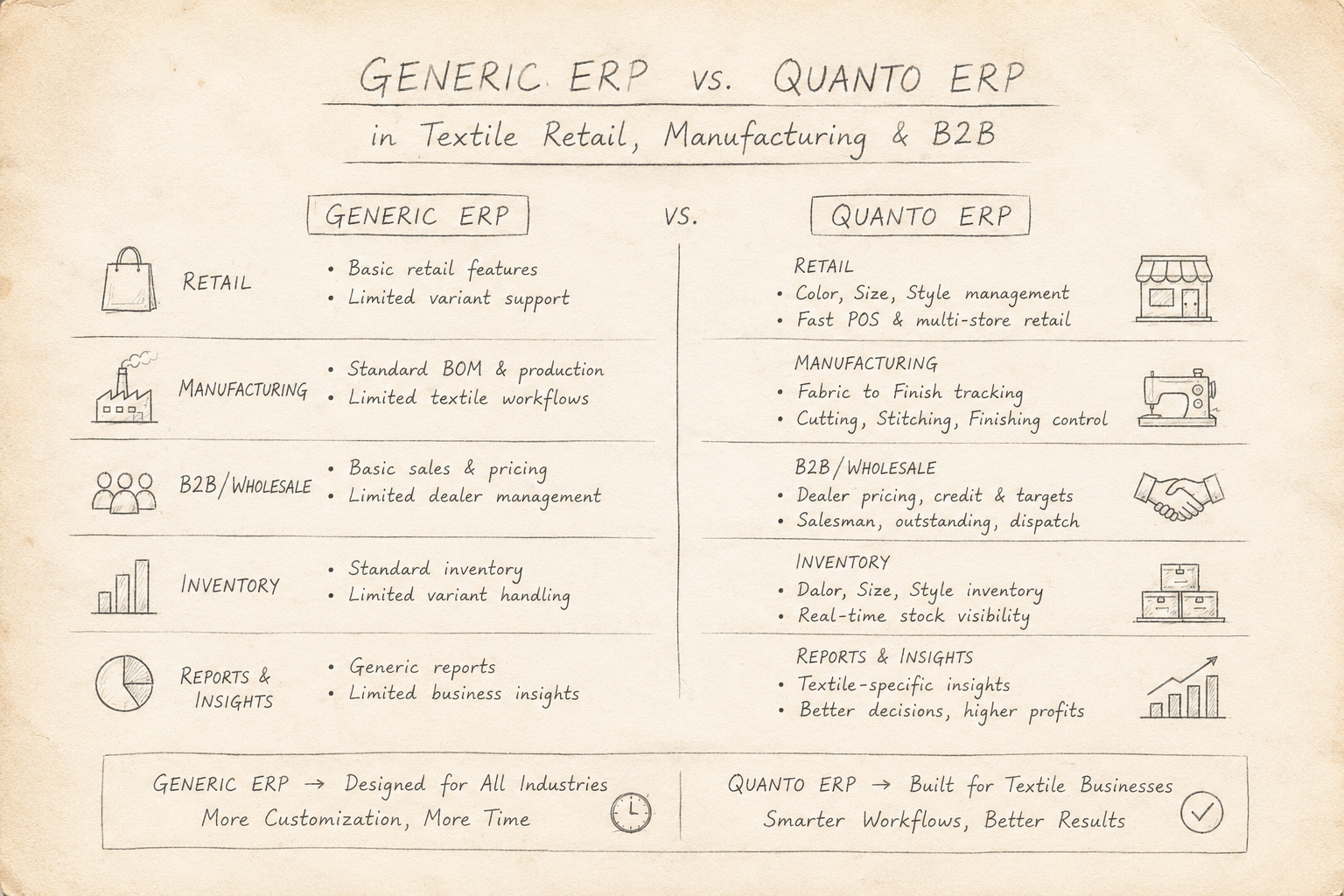
The Hidden Cost of Using a Generic ERP in the Textile Industry
Choosing an ERP is one of the most important technology decisions for a textile business. Many companies initially adopt a generic ERP because it promises to manage finance, inventory, sales, and purchasing under one roof.
While these systems work well for businesses with standardized products and simple workflows, the textile industry operates under an entirely different set of rules. From color and size matrices to seasonal collections, manufacturing complexities, and wholesale distribution, textile businesses require an ERP that understands the industry—not one that forces the industry to adapt to the software.
This is where Quanto ERP stands apart.
The Textile Industry Isn't Generic
Unlike many industries, textile businesses deal with challenges such as:
- Thousands of product variants
- Color, size, fit, and style combinations
- Seasonal launches
- Fast-changing fashion trends
- Multi-store retail operations
- Manufacturing planning
- Wholesale and distributor management
- Fabric consumption tracking
- Inventory movement across warehouses and stores
Managing these processes manually—or through a generic ERP—often creates unnecessary complexity.
Generic ERP: Designed for Everyone
A generic ERP is built to serve multiple industries, including:
- Trading
- Electronics
- Automotive
- Pharmaceuticals
- Construction
- Distribution
- Manufacturing
Because it must accommodate every industry, textile-specific workflows usually require:
- Extensive customization
- Third-party integrations
- Manual spreadsheets
- Additional software
- Higher implementation costs
The result is a system that works—but never truly fits.
Quanto ERP: Built for Textile Businesses
Quanto ERP is designed specifically for textile retailers, manufacturers, and wholesalers.
Instead of adapting a generic workflow, it reflects how textile businesses actually operate every day.
Whether you're managing a single showroom or a multi-location enterprise, the software brings every department together on one platform.
Retail Operations Comparison
| Feature | Generic ERP | Quanto ERP |
|---|---|---|
| Color & Size Matrix | Basic support through customization | Native support |
| Style-wise Inventory | Limited | Built-in |
| Barcode Integration | Generic | Optimized for textile retail |
| Multi-store Inventory | Available but generic | Designed for fashion retail |
| Store Transfers | Manual workflows | Streamlined |
| Seasonal Collections | Custom setup required | Built into inventory structure |
| Retail Billing | Standard invoicing | Fast textile POS workflows |
| Customer Purchase History | Basic CRM | Fashion-focused customer insights |
Manufacturing Comparison
Textile manufacturing is far more complex than standard manufacturing.
Production depends on:
- Fabric
- Color variations
- Dye lots
- Cutting
- Stitching
- Finishing
- Quality control
A generic ERP often treats manufacturing as a standard Bill of Materials (BOM) process.
That approach misses many textile-specific realities.
Generic ERP Manufacturing
- Generic BOM
- Standard production orders
- Limited textile workflow support
- Manual production tracking
- Extra customization for garment processes
Quanto ERP Manufacturing
- Fabric consumption tracking
- Production planning
- Cutting management
- Stitching workflow
- Finishing process tracking
- Work order monitoring
- Production status visibility
- Material requirement planning
- Inventory linked directly to production
This allows manufacturers to monitor every stage—from raw fabric to finished garments.
Wholesale & B2B Comparison
Wholesale businesses require entirely different workflows compared to retail.
Distributors expect:
- Bulk pricing
- Dealer discounts
- Credit management
- Sales representative tracking
- Outstanding payments
- Distributor-wise inventory
- Order approvals
Generic ERP systems typically provide basic sales modules that require additional customization.
Quanto ERP includes wholesale functionality tailored to textile distribution.
Features include:
- Dealer management
- Distributor pricing
- Customer-specific rate lists
- Salesman performance
- Credit limit monitoring
- Outstanding tracking
- Order management
- Dispatch planning
- B2B invoicing
- Territory-wise sales reporting
Inventory Management
Inventory is where most textile businesses lose money.
A single shirt may exist in:
- 6 colors
- 8 sizes
- Multiple warehouses
- Several retail outlets
That creates hundreds of stock combinations.
Generic ERP
- Standard inventory
- Manual variant configuration
- Limited matrix handling
- Difficult stock visibility
Quanto ERP
- Color-wise inventory
- Size-wise inventory
- Style-wise inventory
- Warehouse-wise tracking
- Store-wise tracking
- Real-time stock visibility
- Fast stock transfers
- Complete inventory accuracy
Reporting & Business Intelligence
Business decisions depend on accurate reporting.
Generic ERP Reports
- Sales
- Purchase
- Accounting
- Inventory
Useful—but generic.
Quanto ERP Reports
In addition to standard reports:
- Best-selling styles
- Slow-moving inventory
- Store performance
- Sales by color
- Sales by size
- Brand-wise performance
- Collection-wise analysis
- Customer buying trends
- Seasonal performance
- Margin analysis
- Production efficiency
- Wholesale performance
These insights help textile businesses make faster, data-driven decisions.
Implementation Experience
One of the biggest challenges with generic ERP solutions is implementation.
Businesses often spend months:
- Mapping workflows
- Customizing modules
- Testing integrations
- Training employees
- Adjusting processes
Even after deployment, users may continue relying on spreadsheets to bridge functionality gaps.
With Quanto ERP, many textile-specific workflows are already built into the system, reducing the need for extensive customization. Teams can adopt processes that closely match their day-to-day operations, leading to faster implementation and smoother onboarding.
Scalability
As textile businesses grow, operational complexity increases.
You may expand from:
- One retail store to multiple outlets
- A local manufacturer to national production
- Direct sales to wholesale distribution
- Domestic business to exports
A textile-focused ERP grows alongside these changing requirements by providing integrated visibility across retail, manufacturing, warehousing, and B2B operations.
Comparison at a Glance
| Area | Generic ERP | Quanto ERP |
|---|---|---|
| Textile Focus | General-purpose | Purpose-built for textile businesses |
| Retail POS | Generic | Optimized for apparel retail |
| Product Variants | Requires configuration | Native color, size, and style management |
| Manufacturing | Standard production | Textile production workflows |
| Wholesale | Basic sales | Complete B2B management |
| Inventory | Standard stock | Textile-specific inventory control |
| Reporting | Generic dashboards | Textile-focused analytics |
| Customization | Often extensive | Minimal for textile operations |
| Time to Value | Longer due to setup | Faster with industry-ready features |
The Bottom Line
Every ERP system can manage accounting, purchasing, and inventory at a basic level. The real difference lies in how well it supports the unique demands of your industry.
For textile businesses, success depends on efficiently handling product variants, seasonal collections, manufacturing workflows, multi-store retail, and wholesale distribution. These are not optional features—they are core business processes.
A generic ERP may require extensive customization to accommodate these needs, increasing implementation time and long-term maintenance. Quanto ERP, on the other hand, is built around the realities of the textile industry, helping businesses streamline operations, improve inventory accuracy, and gain actionable insights without unnecessary complexity.
If your goal is not just to run an ERP but to build a more agile, scalable, and profitable textile business, choosing an industry-focused solution can make a significant difference.