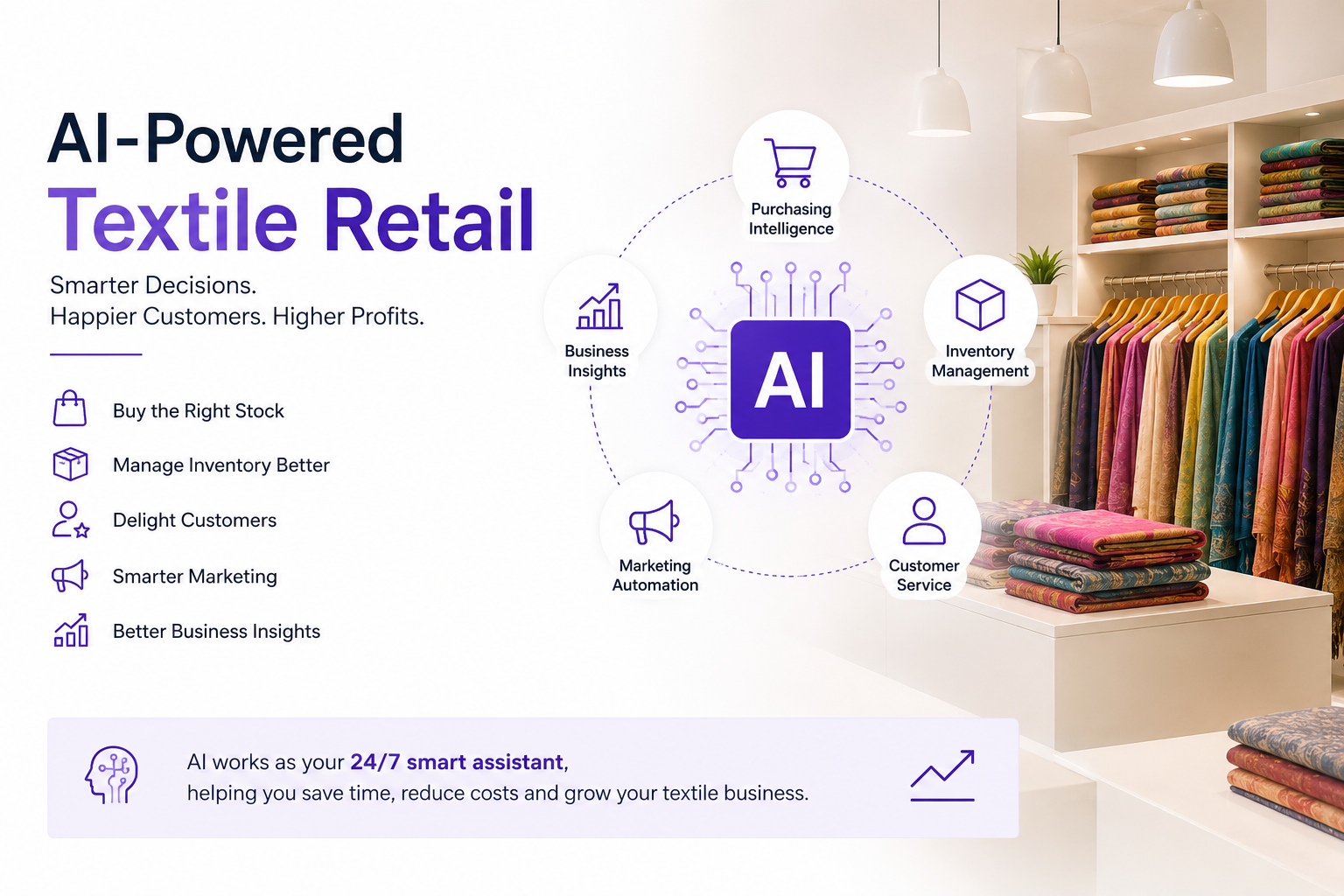
Running a textile showroom today is more challenging than ever. Customers expect better collections, faster service, personalized recommendations, and competitive prices. At the same time, retailers have to manage inventory, staff, suppliers, customer relationships, and increasing competition from online stores.
This is where Artificial Intelligence (AI) is making a real difference.
AI is no longer only for large brands like Amazon or Myntra. Today, even small and medium textile retailers can use AI-powered tools to improve daily operations, reduce costs, and increase sales.
Let's explore how.
1. AI Helps You Purchase the Right Stock
One of the biggest challenges in textile retail is buying the right products.
Buying too much creates dead stock.
Buying too little results in lost sales.
Instead of relying only on experience, AI analyzes:
- Previous sales
- Seasonal trends
- Festival demand
- Customer preferences
- Fast-moving products
Then it suggests what you should purchase.
Example
Suppose your showroom sold:
- 350 cotton shirts last summer
- 500 kids' ethnic wear during Deepavali
- 1200 sarees during wedding season
AI studies this history and predicts the demand for the coming season, helping you place more accurate purchase orders.
Result
- Less unsold stock
- Better cash flow
- Faster inventory turnover
2. AI Makes Inventory Management Easier
Many retailers lose money because they don't know:
- Which items are selling fast
- Which products are sitting in the racks for months
- Which sizes are running out
AI continuously monitors inventory.
It can instantly identify:
- Slow-moving stock
- Fast-selling items
- Low-stock alerts
- Overstocked products
Example
Your store has:
- 180 black formal shirts
- Only 5 white shirts left
AI automatically alerts you to reorder white shirts while recommending promotional offers to clear excess black shirts.
Instead of checking racks manually, AI does the analysis in seconds.
3. AI Helps You Sell More
Today's customers expect personalized shopping.
AI can recommend products based on previous purchases.
Example
A customer buys:
- Silk saree
AI recommends:
- Matching blouse material
- Petticoat
- Jewelry
- Handbag
Another customer purchases:
- Men's formal shirt
AI suggests:
- Matching trousers
- Belt
- Tie
- Wallet
This increases the average bill value without forcing additional sales.
4. AI Improves Customer Service
Customers often ask:
- Do you have this color?
- Is this available in XL?
- Do you have similar designs?
Instead of searching manually, AI instantly checks the inventory.
Some retailers even use AI chat assistants on:
- Website
- Mobile App
Customers receive instant responses, even after business hours.
Example
A customer messages at 10:30 PM:
"Do you have green cotton sarees under ₹2,000?"
The AI assistant replies with available options, prices, and photos.
The customer may visit your store the next day.
5. AI Helps You Retain Customers
Getting a new customer costs much more than retaining an existing one.
AI helps retailers build stronger customer relationships.
It remembers:
- Purchase history
- Favorite brands
- Preferred colors
- Sizes
- Birthday
- Anniversary
Based on this information, AI automatically sends personalized messages.
Example
"Hello Mrs. Lakshmi,
Our new silk saree collection has arrived. Based on your previous purchases, we thought you might like these new wedding designs."
Customers appreciate personalized communication.
This increases repeat visits.
6. AI Helps You Plan Offers
Many retailers offer discounts without knowing whether they are necessary.
AI studies sales patterns and recommends:
- Which products need offers
- Which products can sell at full price
- Best time to run promotions
Example
AI identifies:
- Linen shirts haven't sold for 60 days.
Instead of giving discounts across the entire store, AI recommends offering 15% only on linen shirts.
This protects your profit margin.
7. AI Makes Visual Merchandising Smarter
The way products are displayed influences customer buying decisions.
AI can suggest:
- Which products should be displayed at the entrance
- Best color combinations
- Trending fashion displays
- Window display ideas
Some AI tools even generate attractive showroom display images before you rearrange your racks.
Example
Upload a photo of your current showroom.
AI creates three alternative display layouts that look more modern and attractive.
Your staff can rearrange the store based on these suggestions.
8. AI Helps Staff Sell Better
Not every salesperson has years of experience.
AI acts as an assistant.
It can suggest:
- Matching products
- Customer recommendations
- Product information
- Alternative items
Example
Customer asks:
"I want something similar but under ₹1,500."
AI instantly recommends suitable alternatives.
The salesperson spends less time searching and more time assisting the customer.
9. AI Creates Marketing Content
Marketing is essential, but creating content regularly can be difficult.
AI can generate:
- Facebook posts
- Instagram captions
- WhatsApp offers
- Festival greetings
- Product descriptions
- Blog articles
- Advertisement slogans
Example
Upload a photo of a new saree collection.
AI writes:
"Celebrate this festive season with elegant silk sarees starting from ₹1,999. Visit our showroom today!"
In just a few minutes, your marketing content is ready.
10. AI Helps Business Owners Make Better Decisions
Every retailer asks questions like:
- Which category gives the highest profit?
- Which supplier delivers the best products?
- Which salesperson sells the most?
- Which branch performs better?
- Which products should be discontinued?
Instead of manually preparing reports, AI generates business insights automatically.
You spend less time analyzing data and more time growing your business.
A Day in an AI-Powered Textile Showroom
Imagine this scenario:
- AI predicts higher demand for cotton kurtis due to rising temperatures.
- It recommends placing a purchase order before competitors.
- Inventory alerts you that popular sizes are running low.
- A customer receives a WhatsApp message about the new arrivals.
- When she visits the store, the salesperson gets AI suggestions for matching leggings and dupattas.
- The billing system records the purchase.
- AI schedules a follow-up message after 30 days with a special loyalty offer.
- Meanwhile, the store owner receives a dashboard showing daily sales, top-performing categories, and slow-moving products.
Every step is connected, making the business more efficient and customer-focused.
Will AI Replace Retailers?
No.
AI cannot replace a retailer's experience, relationships, or understanding of local customers.
Instead, AI works as a smart assistant.
It handles repetitive tasks, analyzes large amounts of data, and provides useful recommendations. The retailer still makes the final decisions.
Think of AI as an experienced business advisor available 24/7.
Conclusion
Artificial Intelligence is transforming textile retail by making purchasing smarter, inventory more accurate, customer service faster, marketing more effective, and decision-making easier.
Retailers who adopt AI today will be better prepared to compete in an increasingly digital market. Whether you own a small boutique or a large textile showroom, AI can help you save time, reduce costs, improve customer satisfaction, and grow your business.
The future of textile retail isn't about replacing people with technology—it's about using AI to make every decision smarter and every customer experience better.