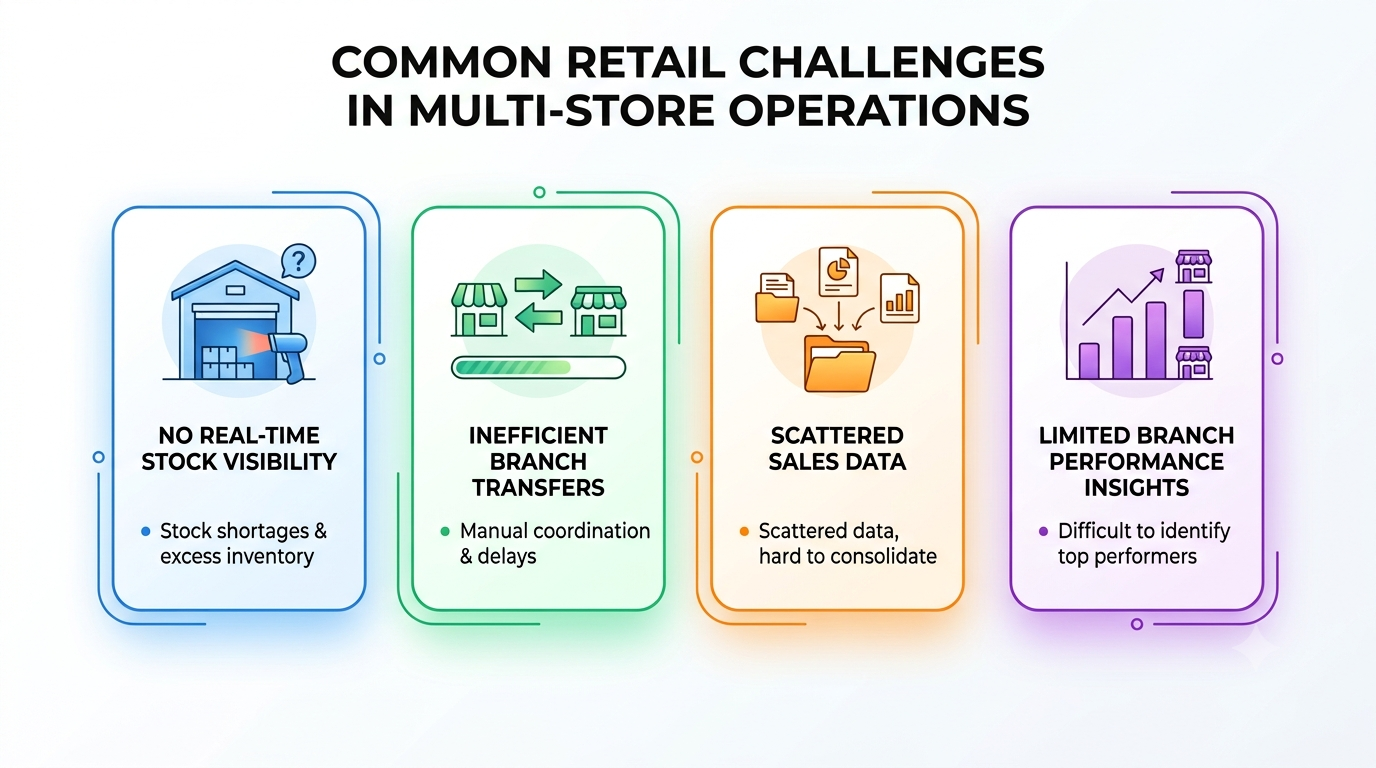
Expanding your textile business to multiple branches is a major achievement, but it also introduces new operational challenges. As the number of stores grows, managing inventory, sales, and staff across different locations becomes increasingly complex. Without a centralized retail management system, retailers often rely on phone calls, spreadsheets, or manual reporting, resulting in delays, errors, and poor business decisions.
1. No Real-Time Stock Visibility
One of the biggest challenges for multi-branch textile retailers is the lack of real-time inventory visibility. Each store maintains its own stock records, making it difficult for owners to know exactly what products are available across all locations.
Imagine a customer walks into one branch looking for a particular saree or shirt size. The staff cannot instantly check whether the item is available in another branch. Instead, they have to call other stores, send WhatsApp messages, or manually verify stock. This wastes valuable time and often results in lost sales when customers choose to shop elsewhere.
Without centralized inventory visibility, retailers also face:
- Frequent stock shortages of fast-moving products.
- Overstocking of slow-moving items.
- Duplicate purchases due to inaccurate stock information.
- Difficulty planning replenishment.
- Poor customer satisfaction caused by unavailable products.
2. Inefficient Branch-to-Branch Stock Transfers
Stock transfers between branches are essential in textile retail, especially during festivals, wedding seasons, and promotional events. However, without an integrated system, these transfers become manual and difficult to track.
Retailers often depend on phone calls, spreadsheets, or handwritten records to request and approve stock movements. This leads to:
- Delayed stock transfers.
- Missing or misplaced inventory.
- Incorrect stock balances.
- Lack of accountability during transportation.
- Increased operational costs.
In many cases, a product is available in another branch but reaches the customer too late because the transfer process is slow and unorganized.
3. Scattered Sales Data Across Branches
Each branch generates its own sales reports, making it difficult for business owners to get a complete picture of overall performance.
Instead of accessing one consolidated dashboard, management has to collect reports from every location, combine spreadsheets, and manually prepare summaries. This process is time-consuming and prone to errors.
As a result, retailers struggle to answer important business questions such as:
- Which branch generated the highest revenue today?
- Which product category performed best this month?
- What is the total business turnover across all locations?
- Which branches require additional inventory?
- Which stores are achieving their sales targets?
Without centralized reporting, decision-making becomes slower and less accurate.
4. Limited Branch Performance Insights
Every branch operates differently based on customer preferences, location, and staff performance. Without detailed branch-wise analytics, retailers cannot identify what is working and what needs improvement.
Lack of performance insights makes it difficult to:
- Compare sales performance between branches.
- Identify top-performing and underperforming stores.
- Measure employee productivity.
- Track branch-wise profit margins.
- Analyze customer buying patterns by location.
- Optimize inventory based on regional demand.
This often leads to poor inventory planning, ineffective marketing strategies, and missed opportunities for business growth.
Managing multiple textile stores without a centralized ERP system results in operational inefficiencies, inventory inaccuracies, delayed decision-making, and lost sales opportunities. As the business grows, these challenges become even more difficult to manage manually.
How Quanto ERP Solves It
With Quanto ERP, all your branches are connected through a single cloud-based platform, enabling you to:
- Monitor stock availability across every store in real time.
- Transfer inventory seamlessly between branches with complete tracking.
- Access consolidated sales, inventory, and financial reports instantly.
- Analyze branch-wise revenue, profitability, and performance from a centralized dashboard.
Manage every branch like it's right next door—with complete visibility, control, and confidence.