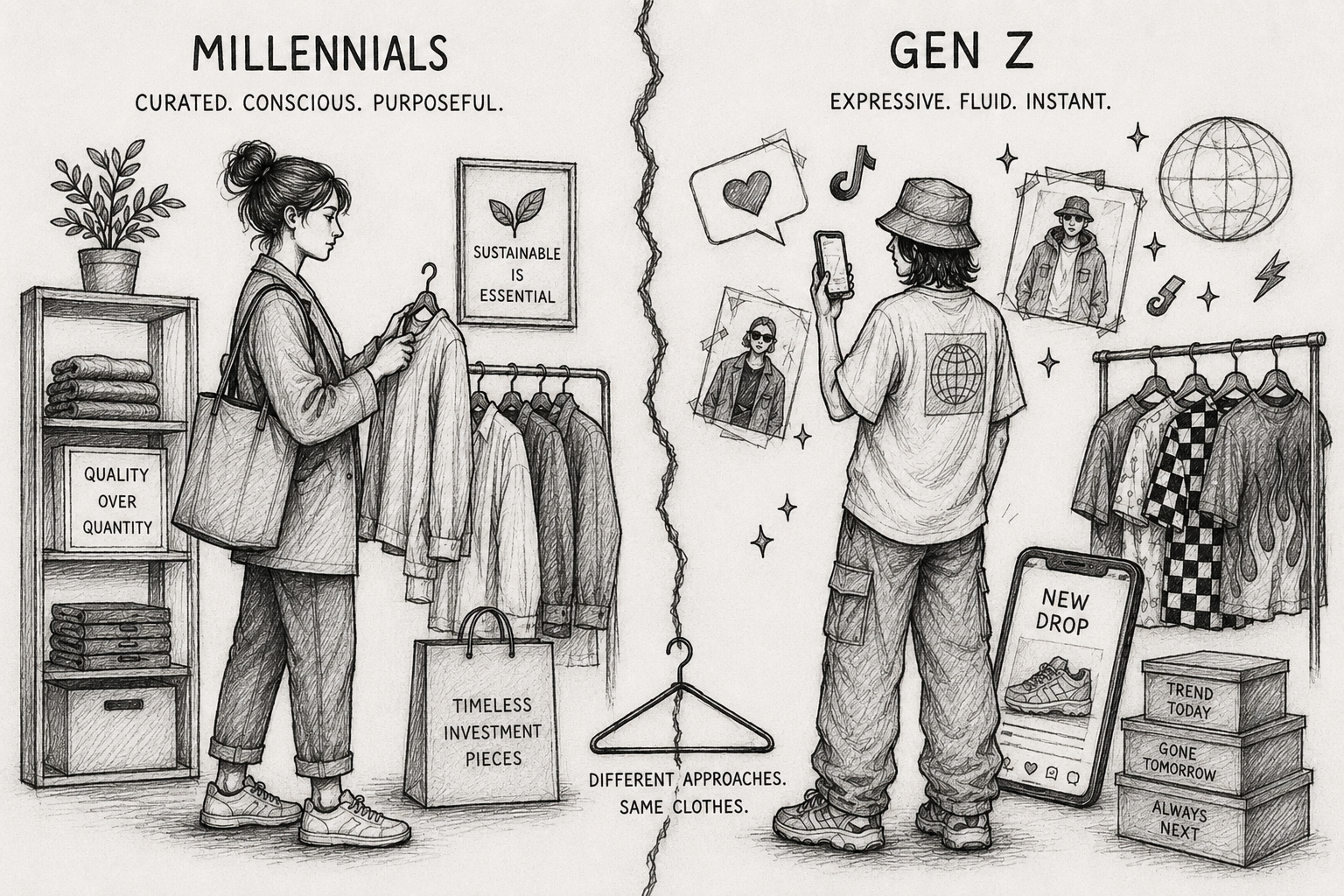
While internet fluency and a vocal commitment to a circular economy unite modern shoppers, their operational strategies for building a wardrobe could not look more different. The modern retail landscape has fractured along generational lines, forcing brands to navigate an entirely new psychological map.
The global apparel market is experiencing a profound behavioral shift. Driven by macroeconomic pressures, advanced generative technologies, and evolving identity markers, consumers are no longer approaching clothing consumption with traditional loyalty. Instead, the industry has split into two heavily defined camps: Millennials, who shop with a focus on stability, curation, and structured lifestyle utility; and Gen Z, who treat fashion as a fluid, rapid-fire extension of online subcultures.
The Generational Breakdown at a Glance
| Trait | Millennials (Ages ~26–45) | Gen Z (Ages ~14–25) |
| Shopping Goal | Curated Essentials: Structural wardrobe building, longevity, multi-use versatility. | Fluid Expression: Aesthetic shifting, mood signaling, hyper-individuality. |
| Discovery Channel | Omnichannel research, editorial content, and intent-driven AI search tools. | Short-form Video: Algorithmic feeds via TikTok, Instagram Reels, and social commerce. |
| Sustainability | Premium alignment with organic, eco-labeled, or ethically corporate certified brands. | Aggressive use of peer-to-peer recommerce and upcycling to circumvent corporate loops. |
| Silhouette Fit | Tailored, polished, "quiet luxury," and high-performance athleisure. | Oversized & Gender-Neutral: Cargo pants, boxy fits, and nostalgic throwback silhouettes. |
1. The Discovery Mechanism: Intentional Search vs. The Algorithmic Feed
The operational pipeline of how a consumer discovers and validates a product marks the sharpest contrast between these demographics.
- Millennials approach shopping with high intent and a desire for verification. They are currently the heaviest adopters of retail-integrated AI search agents, using them to cross-reference customer reviews, scan textile composition sheets, and track historical markdown cycles. They lean heavily into "webrooming"—extensively researching online before completing a transaction in a physical boutique.
- Gen Z relies entirely on the serendipity of the algorithmic feed. Over 55% of Gen Z consumers report purchasing clothing directly after encountering it on a short-form video feed. Rather than navigating to traditional search engines or brand storefronts, they utilize video content to assess how a textile drapes, moves, and reflects real-world conditions. For Gen Z, traditional stylized studio photography feels artificial; they demand the unfiltered context of a creator's video review.
2. The Resale Ecosystem: Luxury Investments vs. Wardrobe Rotation
While both cohorts are actively accelerating the explosive growth of the secondary clothing market, their underlying motivations point in opposite directions:
- For Millennials, resale is an functional gateway. They lean toward structured, authenticated platforms like The RealReal or Vestiaire Collective to source designer pieces that would otherwise sit outside their discretionary budget. It is viewed as an investment strategy—buying into long-term quality and classic tailoring that retains structural and market value.
- For Gen Z, peer-to-peer thrift apps are a dynamic lifestyle channel. Utilizing platforms like Depop and Vinted, they treat the digital thrift market as an archive for hyper-individual expression. They actively hunt for nostalgic, unbranded, or Y2K subculture pieces to stand out from retail monotony. Crucially, they view their wardrobes as fundamentally circular, frequently purchasing a garment, wearing it for digital content, and immediately listing it back online for resale.
3. Design Philosophies: Holistic Wellbeing vs. Radical Informality
The silhouette preferences of both groups reveal how they navigate their day-to-day environments.
- Millennials have embraced the "wellbeing era," populating their wardrobes with elevated, cross-functional clothing that bridges the gap between hybrid remote work and wellness routines. Brands providing highly reliable, minimalist "capsule" staples are favored because they reduce daily cognitive load while maintaining an effortless professional polish.
- Gen Z has largely discarded traditional notions of formal polish. Their style philosophy embraces body neutrality, heavy structural utility, and radical informality. Oversized garments, multi-pocket cargo pants, and fluid knitwear dominate their aesthetic, allowing them to cross gender boundaries seamlessly. For Gen Z, mixing a fast-fashion accessory with a rare thrifted piece and a premium streetwear item is not a contradiction; it is the ultimate expression of personal curation.
The Forward Horizon: As Millennials tighten their budgets by demanding absolute transparency and defensible longevity from established mid-to-high tier brands, Gen Z is bypassing traditional retail loops altogether. The future of fashion survival relies entirely on a brand’s ability to move away from static marketing and adapt to an agent-first, creator-validated ecosystem.