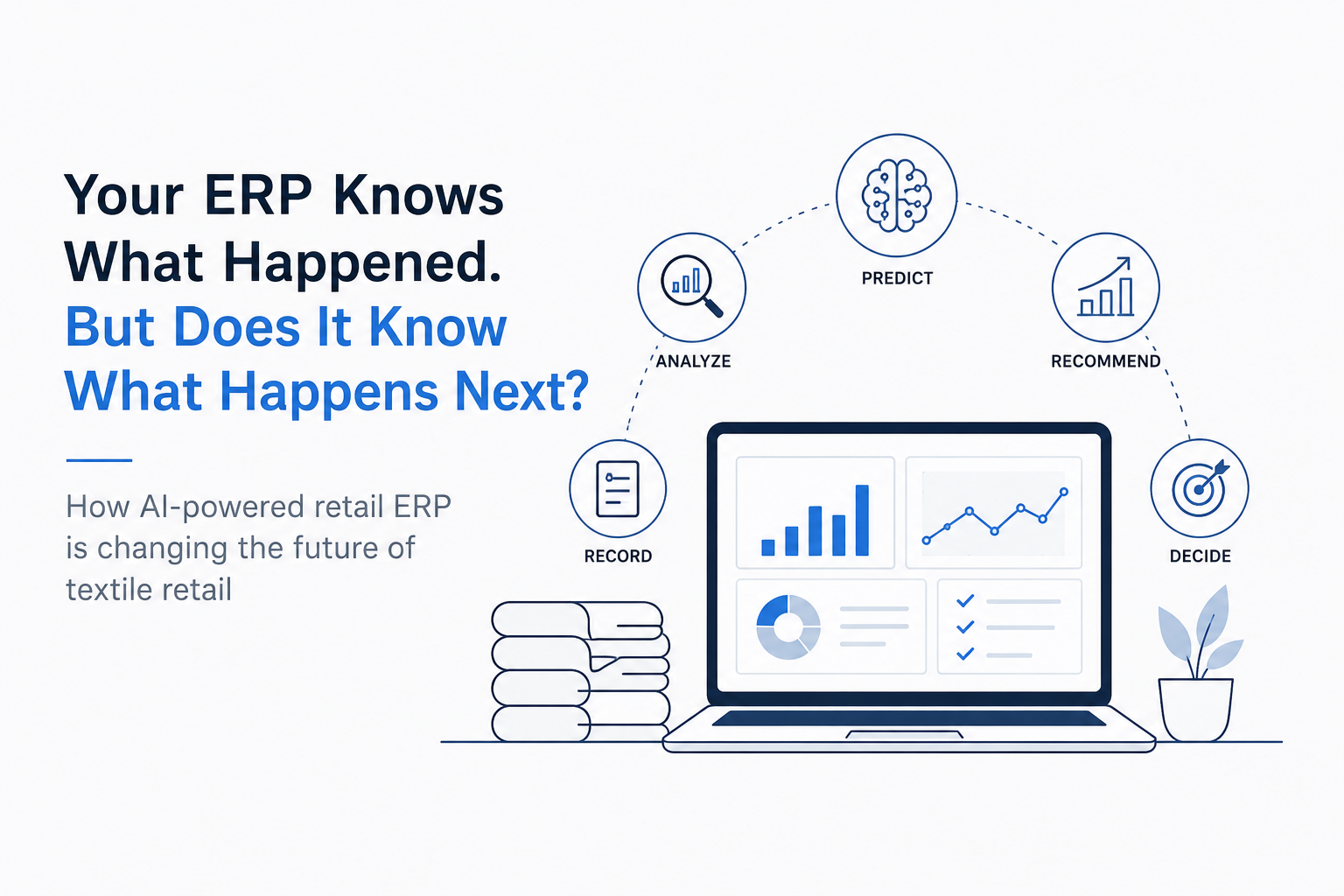
Why the next generation of textile retail ERP is moving from reporting the past to predicting the future
A customer buys a shirt. Your ERP records the sale.
Another customer buys the same shirt in a different size. The system records that too.
At the end of the month, your ERP tells you that the shirt sold 420 pieces.
Great.
But here is the question that matters:
What should you do next?
Should you reorder it? Which sizes should you buy? Which branch needs more stock? Is demand increasing or was it just a temporary spike?
This is where the future of textile retail ERP is heading.
The next generation of retail technology isn't just about recording what happened. It is about helping retailers understand what is happening, what could happen next, and what action they should consider taking.
From Billing Software to Intelligent Retail
Traditional retail software was designed primarily to record transactions and manage operations.
It answers questions like:
- What did we sell?
- How much stock do we have?
- What did we purchase?
- Which products sold the most?
- What were our sales last month?
These are important questions—but they are mostly about the past and present.
Modern textile retailers need another level of intelligence:
- What will customers likely buy next?
- Which products need replenishment?
- Which stock is becoming slow-moving?
- Which branch has excess inventory?
- Which products are losing momentum?
- Which customers are likely to purchase again?
This represents a major shift:
Record → Report → Analyse → Predict → Recommend
The future of retail ERP is moving toward the final two stages.
Why Textile Retail Needs Smarter Technology
Textile retail is more complicated than simply counting products.
A single product can have multiple:
Brands + Designs + Colours + Sizes + Fits + Price Points + Locations
Demand can also change because of:
Season + Festivals + Local Preferences + Promotions + Fashion Trends + Social Media
A shirt that sells quickly in one branch may remain unsold in another.
A particular size may disappear from the shelf while other sizes remain untouched.
A colour that was popular last season may suddenly slow down.
This is why simply knowing your total inventory isn't enough.
Retailers need to know:
Which inventory matters, where it matters, and when it matters.
The Difference Between Data and Intelligence
Consider two ERP systems.
System A
"Blue shirts sold 420 units last month."
That's data.
System B
"Blue shirts have increased sales velocity over the last four weeks. XL and XXL are driving the growth, while current stock may require replenishment soon."
That's intelligence.
The difference isn't the amount of data.
The difference is what the system does with the data.
An intelligent retail ERP can analyse sales history, inventory levels, product movement and branch performance to help retailers identify patterns that might otherwise take hours of manual analysis.
AI-Powered Inventory Management: From Reactive to Proactive
Inventory is one of the biggest challenges in textile retail.
Too much inventory means:
Capital blocked + storage costs + discounts + dead stock
Too little inventory means:
Lost sales + disappointed customers + missed opportunities
The objective isn't to have maximum inventory.
It is to have the right inventory at the right place at the right time.
AI and retail analytics can help retailers identify:
Fast-moving products
Items that may require faster replenishment.
Slow-moving products
Products that may need attention before they become dead stock.
Stock ageing
Inventory that has remained unsold for extended periods.
Branch-level opportunities
Stock that may be better utilized at another location.
Replenishment signals
Products approaching low-stock levels based on recent movement.
This turns inventory management from a reactive process into a more proactive one.
What If Your ERP Could Help You Decide What to Buy?
Purchasing is one of the most important decisions in textile retail.
Traditionally, purchase decisions often depend heavily on experience and historical sales.
Experience will always matter.
But imagine combining that experience with thousands of transactions.
An intelligent retail system could identify patterns across:
- Product performance
- Size movement
- Colour preferences
- Seasonal demand
- Branch performance
- Sales velocity
- Historical purchasing behaviour
Instead of simply saying:
"This product sold well."
The system can move toward:
"This product is showing sustained demand and may require replenishment."
The retailer remains in control.
Technology simply provides better information at the right time.
Your POS Data Is More Valuable Than You Think
Every transaction generates information.
Every sale.
Every return.
Every discount.
Every size.
Every colour.
Every customer.
Every branch transfer.
Individually, these may look like ordinary transactions.
Collectively, they can reveal how your business behaves.
This is where retail analytics becomes powerful.
Retailers can use connected data to understand:
- Which products generate repeat purchases
- Which categories perform best
- Which branches are growing
- Which products are ageing
- Which customer segments are valuable
- Where sales opportunities exist
The challenge is no longer:
"Do we have data?"
Most retailers do.
The real question is:
"Are we turning our data into decisions?"
How Quanto Retail Fits Into the Intelligent Retail Future
For a modern textile retailer, ERP should be more than a billing application.
Quanto Retail brings key retail operations together, helping businesses manage areas such as sales, inventory, purchasing, stores and customer information through a connected retail platform.
The real value of connected retail technology comes from bringing these pieces together:
Purchase
↓
Inventory
↓
Stores
↓
POS
↓
Customers
↓
Sales
↓
Analytics
When these systems are connected, retailers can build a clearer picture of what is happening across the business.
The next opportunity is to use AI and advanced analytics to move from simply showing information toward identifying patterns, highlighting exceptions and supporting better decisions.
That is the difference between an ERP that records retail and a platform that helps retailers understand retail.
The Future ERP Won't Just Show You Problems
Imagine opening your retail dashboard in the morning.
Instead of searching through dozens of reports, you see:
Inventory Alert:
Several products are approaching low-stock levels.
Dead Stock Alert:
A group of products has shown prolonged slow movement.
Branch Opportunity:
Some inventory may be better utilized at another location.
Demand Signal:
A category is showing sustained growth.
Customer Opportunity:
Existing customers may be relevant for a new product launch.
This is where ERP starts becoming more than software.
It becomes a decision-support system.
Will AI Replace Retailers?
No.
The better question is:
Will retailers who use intelligent technology outperform retailers who don't?
AI cannot replace local market knowledge, customer relationships or years of retail experience.
But it can help retailers process information faster.
The winning combination is:
Retail Experience + Business Data + AI Intelligence
The retailer provides judgement.
The ERP provides operational information.
AI helps identify patterns.
Together, they can support better decisions.
The New Competitive Advantage: Decision Speed
Retail competition isn't only about price, location or product range anymore.
Another advantage is emerging:
Decision Velocity
How quickly can a retailer:
Detect → Understand → Decide → Act
A retailer who identifies a fast-moving product today can potentially replenish it before a competitor reacts.
A retailer who identifies ageing inventory early can take action before deep discounts become necessary.
A retailer who understands customer behaviour can create more relevant marketing.
Small improvements in decision speed can create significant business advantages over time.
So, What Should Your ERP Do Next?
Don't ask only:
"Can my ERP generate reports?"
Ask:
"Can it help me understand those reports?"
Then ask the bigger question:
"Can it help me decide what to do next?"
The evolution of retail technology is clear:
Billing → ERP → Analytics → AI → Predictive Intelligence
The future isn't about having more dashboards.
It is about having better answers.
Not more data.
More useful intelligence.
Not simply knowing what happened yesterday.
Being better prepared for tomorrow.
For textile retailers, the next generation of ERP will not simply record transactions.
It will help connect products, inventory, customers and business data to support smarter decisions.
And that brings us back to the most important question:
Your ERP knows what happened. But does it know what happens next?
Quanto Retail — Building smarter technology for the future of textile retail.
Frequently Asked Questions
What is an intelligent retail ERP?
An intelligent retail ERP combines traditional business management capabilities with analytics and AI to help retailers understand business patterns, identify risks and opportunities, and support better decisions.
How can AI help textile retailers?
AI can analyse sales, inventory, customer and product data to identify patterns such as demand changes, slow-moving inventory, replenishment opportunities and customer behaviour.
Why is inventory management important in textile retail?
Textile retailers manage products across multiple sizes, colours, designs, brands and locations. Effective inventory management helps reduce excess stock while ensuring popular products are available when customers need them.
What is the difference between ERP and AI-powered ERP?
Traditional ERP primarily records and manages business operations. AI-powered ERP can add intelligent analytics, pattern recognition, predictions and recommendations to help retailers make more informed decisions.
Can small textile retailers use intelligent ERP?
Yes. Cloud-based retail ERP makes advanced retail technology increasingly accessible to small and medium-sized businesses. Retailers can start with core POS and inventory management and gradually adopt analytics and AI capabilities.
What is the future of textile retail technology?
The future is moving toward connected, data-driven and AI-assisted retail, where ERP, POS, inventory, customer data, e-commerce and analytics work together to help retailers make faster and more informed decisions.